TWINS TRIVIA is hopefully a fun and informative site that will help you to better enjoy the Minnesota Twins and their wonderful history. “History never looks like history when you are living through it” – John Gardner, former Secretary of Health
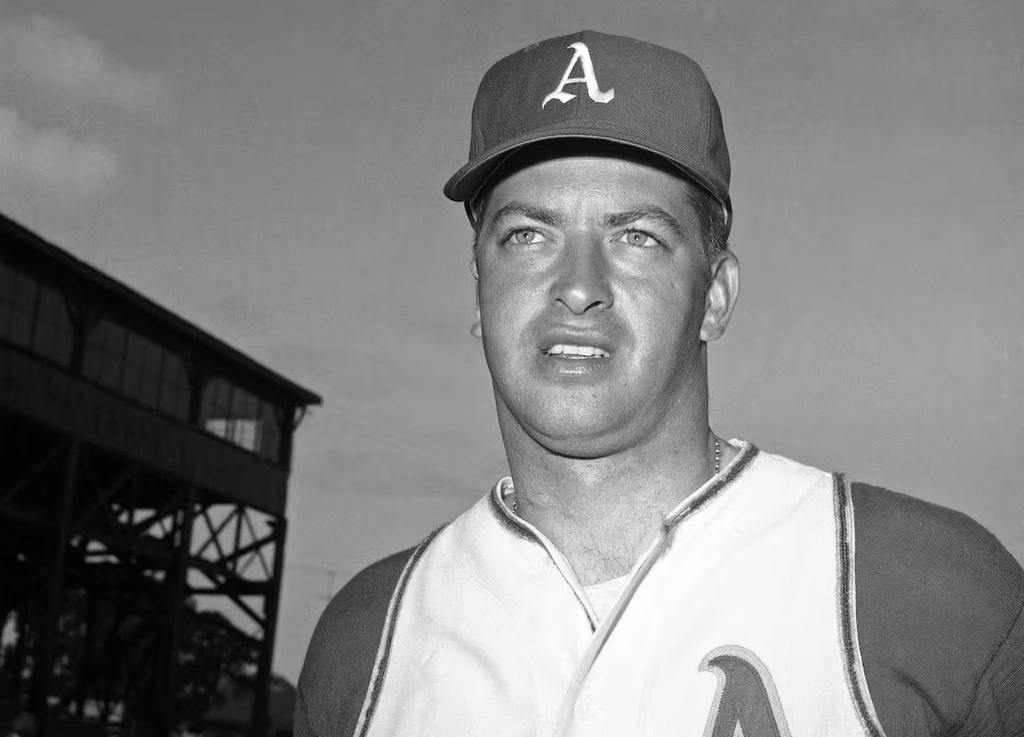
Former Major League reliever and for a brief time the Minnesota Twins closer, Ken Sanders passed away on November 14, 2026, in Hales Corners, Wisconsin, at the age of 85. Over a 10-year big-league career spanning nine different franchises from 1964 to 1976, the right-hander nicknamed “Bulldog” and “Daffy” carved out a remarkable niche as a rubber-armed fireman, posting a sharp 2.97 career ERA with 86 saves across 409 appearances—all but one of them out of the bullpen.
Born in St. Louis to a long time police detective, Sanders was an all-state high school soccer player and three-sport standout before signing with the Kansas City Athletics in 1960 after just a month at Saint Louis University. He initially struggled as a fastball-heavy minor league starter until a Double-A manager moved him to the bullpen and taught him a slider. Sanders reached the majors with Kansas City in 1964 and bounced between the Athletics and the Boston Red Sox over the next few seasons, including a brief 1968 stop in Oakland after the A’s relocated west.
As Major League Baseball and the MLB Players Association begin positioning themselves for the next round of collective bargaining negotiations, the conversation is already becoming familiar. Owners are talking about competitive balance. Players are talking about protecting free-market compensation. Fans are bracing for another public battle between billionaires and millionaires and the possibility of no major league baseball in 2027. The debate is often framed as a simple fight between ownership and labor. In reality, it is much bigger than that.
What is at stake is the future competitive structure of Major League Baseball, the financial health of all 30 franchises, and perhaps most importantly, whether the game can maintain credibility with fans who increasingly question whether every team is truly operating on the same playing field.
For many years, I leaned instinctively toward the players’ side in labor disputes. Players are the product. They are the reason fans buy tickets, watch games, and purchase merchandise. Without them, there is no Major League Baseball. Today, however, I find myself looking at the issue from a different perspective. Not because I oppose players earning more money, but because the current economic system appears to be failing both fans and competitive balance.
What Each Side Is Proposing
Although negotiations remain in their early stages, the two sides have already revealed dramatically different visions for baseball’s future.
The owners’ proposal centers on a system that would, for the first time in Major League Baseball history, establish both a payroll floor and a payroll ceiling in 2028. Under reports circulated during negotiations, teams would be required to spend at least approximately $180 million on player payroll while being limited to approximately $258 million at the upper end. Ownership has also discussed a system in which baseball revenues would effectively be shared equally between owners and players, along with adjustments to free agency, minimum salaries, and player compensation programs. From the owners’ perspective, the objective is simple: create a more balanced competitive environment while ensuring that every franchise participates financially in building a competitive roster.
The Players Association has rejected any form of salary cap, viewing it as a restriction on the free-market system that players fought decades to establish. Instead, the union has advocated for stronger requirements that revenue-sharing funds actually be invested in player payroll, higher minimum salaries, expanded arbitration opportunities, earlier paths to free agency for some players, and increased penalties for organizations that consistently field low-cost rosters. From the players’ perspective, the problem is not that some teams spend too much. The problem is that too many teams spend too little. Both arguments contain elements of truth.
The challenge for baseball is finding a framework that addresses both concerns simultaneously. We can’t have a one side wins all here, it has to be a compromise where each side takes some wins and some losses. Right now negotiations look like politics in America, neither side wants to budge. Did you pay attention to the last election? The people were not happy and they spoke up with their votes and heads rolled. Maybe, just maybe, Major League owners and players can show the Republicans and the Democrats how to compromise in a way that both sides can walk away semi-satisfied and the fans can walk away as winners because without them, there will be no need for major league baseball.
25-year major league pitching career, spanning from 1959-1983, mostly spent with the Senators/Twins for 15 years, and the remainder spread across the Cardinals, Phillies, White Sox, and Yankees.
“Kitty” pitched in 898 games, started 625 and had 180 complete games.
Three-time All-Star, and winner of an impressive 16 Gold Glove Awards.
He had 20+ wins three times, including in 1966 when he led the AL in wins with a 25-13 record.
He was a good hitter as a pitcher, with a .185 average, 16 HR, scored 117 runs and 106 RBI in 1,363 PA.
Overall, he had a 283-237 (.544) record, 2,461 strikeouts, a 3.45 ERA, and a 108 ERA+
Career WAR is 45.2
In 1983, he became the last major league player to have played in the 1950s and the last player for the original Washington Senators to retire.
At the time of his retirement, Kaat’s 25-year career was the longest of any pitcher in major league history. He is now third all-time, behind Nolan Ryan‘s 27 years and Tommy John‘s 26.
Upon retirement as a player, Kaat served a short stint with the Cincinnati Reds as the club’s pitching coach. When Pete Rose took over in 1984 as the Reds’ player/manager, he made good on a promise to Kaat, his former Philadelphia Phillies teammate, and hired the former hurler for his coaching staff. Kaat would coach part of the 1984 season and all of 1985.
After a four decade broadcasting career, Kaat announced his retirement from broadcasting on August 18, 2022. From 1997 to 2005, Kaat won 7 Emmy Awards for excellence in sports broadcasting.
George Thomas, the Minnesota native who played 13 major league seasons with the Detroit Tigers, Los Angeles Angels, Boston Red Sox, and Minnesota Twins before later coaching the University of Minnesota baseball program, passed away on October 23 at the age of 88.
Born on November 29, 1937, in Minneapolis and raised in Bloomington, Thomas developed into one of Minnesota’s finest young athletes. After attending the University of Minnesota, he signed with the Detroit Tigers organization and reached the major leagues as a teenager, beginning a professional baseball career that would span parts of 13 seasons.
Thomas debuted with the Tigers in 1957 and later became part of the expansion Los Angeles Angels during their inaugural 1961 season. He enjoyed one of the best stretches of his career that year, batting .280 with 13 home runs in just 79 games after joining the Angels. His versatility and athleticism quickly made him a valuable player capable of contributing in numerous roles.
After returning to Detroit, Thomas produced his finest full major league season in 1964 when he batted .286 with career highs of 12 home runs and 44 RBI. He continued to establish a reputation as one of the game’s most dependable utility players, earning playing time at nearly every position on the field.
Hall of Famer (member of the five-man inaugural class)
21-year major league pitching career, spanning from 1907-1927, all with the Washington Senators
He had 20+ wins twelve times, including leading the AL in wins six times, with a career-best 36-7 record and a 1.14 ERA in 1913
.He led the AL in ERA five times and strikeouts twelve times, including a career-high 313 K in 1910
.He pitched a no-hitter on July 1, 1920
.He is the all-time MLB leader with 110 shutouts, is second in wins (417), third in innings pitched (5,914.1), and 11th in strikeouts (3,509)
.He was an above-average hitter for a pitcher, with a .235/.274/.341 slash line.
Overall, he had a 417-279 (.599) record, a 2.17 ERA, and a 147 ERA+. From 1907-1919, during the Deadball Era of his career, he had an amazing 1.65 ERA and 172 ERA+.
Career WAR was 155.4
He was also a major league manager for the Senators from 1929-32 and the Indians from 1933-35.
The Appleton native won 222 games across 19 major league seasons, helped lead the Miracle Mets to a World Series championship, earned two All-Star selections and returned home to become a 20-game winner for the Minnesota Twins.
When baseball fans discuss the greatest players ever produced by Minnesota, Jerry Koosman’s name belongs near the top of the list. The Appleton native fashioned a remarkable 19-year major league career that included 222 victories, a World Series championship, two All-Star selections and a memorable homecoming with the Minnesota Twins. Koosman, who passed away at age 83, leaves behind a legacy that stretched from the farm fields of western Minnesota to baseball’s grandest stage.
Though often overshadowed by Hall of Fame teammate Tom Seaver and rookie-card partner Nolan Ryan, Koosman built a career that stood comfortably on its own merits. A fierce competitor with exceptional durability, he logged nearly 3,900 innings, struck out 2,556 batters and earned the respect of teammates and opponents alike. By the time his career ended in 1985, he had established himself as one of the finest left-handed pitchers of his generation and one of the most accomplished players ever born in the North Star State.
From Appleton to the Big Leagues
Born Dec. 23, 1942, in Appleton, Minnesota, Jerome Martin Koosman grew up on a farm near Morris, where hard work was a daily expectation rather than a choice. Those roots would shape the no-nonsense approach that characterized his entire baseball career. After serving in the U.S. Army, Koosman’s pitching talent attracted the attention of professional scouts, and he eventually signed with the New York Mets organization in August of 1964.
Koosman reached the major leagues in 1967 and immediately showed he belonged. In 1968, he emerged as one of baseball’s brightest young stars, posting a 19-12 record with a sterling 2.08 ERA while finishing second in National League Rookie of the Year voting. The performance earned him the first of two consecutive All-Star selections and established him as a central figure in a young Mets rotation that was quickly becoming one of the game’s best.